


Select your Market
-
{{ userContent.title }}

{{ userContent.lookingForMoreLabel }}


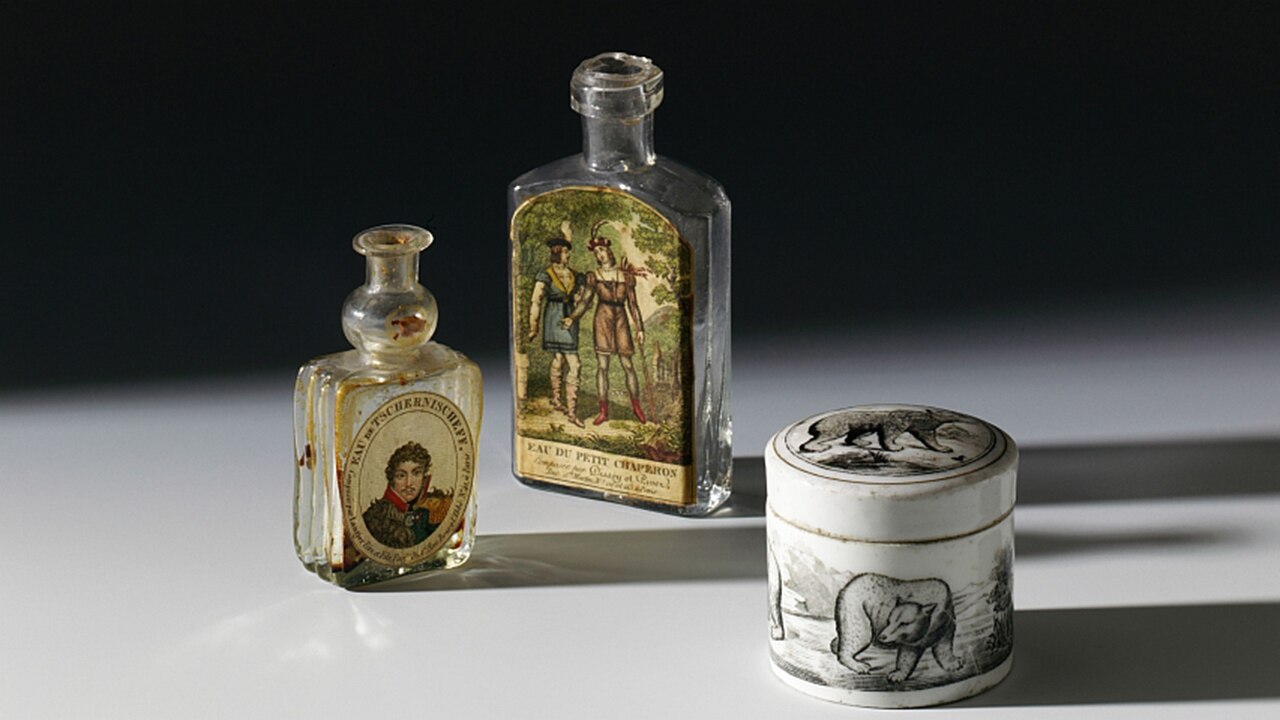
Packaging for cosmetics, 19th century
textblock default title
Not only medicines, but also fragrant distillates and ointments for cosmetic use have long been among the products manufactured and sold in European pharmacies. For this reason, the Corporate History collection also includes some commercial packaging for cosmetics.
Initially, Italy played an important role, but at the latest since the reign of Louis XIV, the focus of production and consumption shifted to France. Above all, Grasse, located in Provence, has been able to assert itself as a center of perfume production to this day, although the importance of the capital Paris must not be underestimated. It is there that the two perfumed waters originated, whose rare labels still appeal today.
The "Eau du petit chaperon" was probably sold in the famous shop "La Reine des Fleurs", which Louis-Toussaint Piver took over from Guillaume Dissey in 1813 – both well-known perfumers of their time, who operated together here.
The "Eau de Tschernyschew" originated from the Parisian manufactory named after father and son Langier, whose lithographed label shows a portrait of Alexander Ivanovich Chernyshev. Chernyshev fought in the Napoleonic Wars, took on diplomatic tasks early on, and was mentioned several times by Theodor Fontane in his book "Before the Storm. A Novel from the Winter of 1812 to 13." In 1815, the field marshal accompanied the Russian Tsar Alexander as adjutant general to the Congress of Vienna; later, he became Minister of War and Chairman of the State Council.
The white-ground porcelain jar contained, as the illustrations suggestively indicate, "Veritable Graisse d'Ours," or real bear fat. This animal substance has long been part of the medieval pharmacopoeia. As early as the 12th century, Hildegard von Bingen recommended applying the lard to the head if the hair was falling out. This timeless cosmetic misconception is quite obviously also the reason that prompted buyers to purchase such a preparation in the early 19th century. Claims about this product's effectiveness are rooted in the symbolic theory of correspondences, which, by simple analogy assumes that the fat of an animal with a lush coat can be used as a hair pomade. Sadly, this belief proved to be as ineffective in the past as it is today.