


Select your Market
-
{{ userContent.title }}

{{ userContent.lookingForMoreLabel }}


ATEX Tools, n. D.
textblock default title
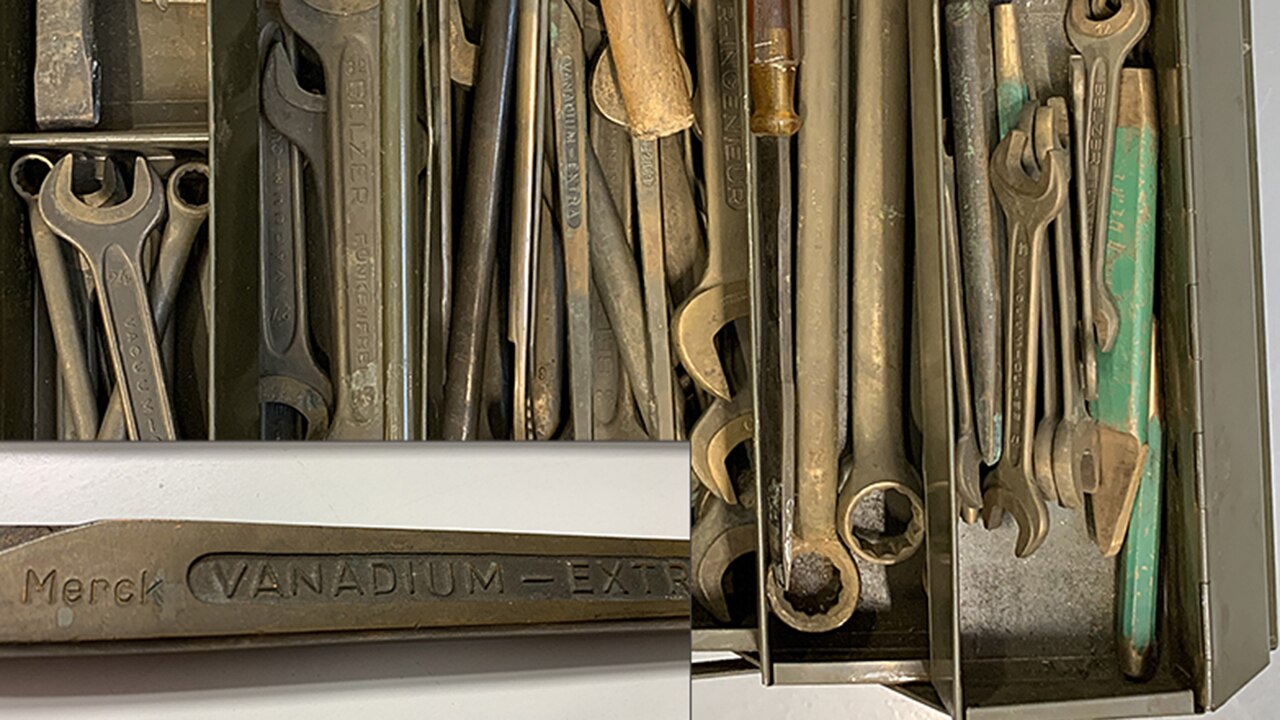
It looks like standard commercial tools, but first impressions are deceptive. Even if the condition of the metal no longer looks like new due to use and age, you can already recognize from the color that these are not items from the usual DIY store range, but that they are special tools.
Last year, Corporate History received this well-stocked toolbox with pliers, hammers, screwdrivers and wrenches of various sizes from the Merck workshops. “Merck” or ‘E. Merck’ is engraved or stamped on every tool in the box. The exact year of origin is not known. What is certain is that the tools have not been used in recent years, making the Corporate History exhibition rooms the ideal place for them.
ATEX refers to the classification of the tool; it is taken from the French term for “ATmosphères EXplosives”. It is non-sparking and suitable for use in potentially explosive environments. It is also non-magnetic. The material from which the parts are made is not the commonly known chrome-vanadium or chrome-molybdenum, from which tools are usually made. Explosion-proof tools are made of vanadium-bronze, aluminum-bronze or copper-beryllium alloys.
In general, copper or its alloys (bronze is already an alloy of copper and tin) is softer than chrome, for example, but spark-free alloys can also be made very hard by post-treatment so that they can be used as tools. The question of why not all tools are spark-free if they have no physical disadvantages such as lower hardness is quickly answered: Metals such as beryllium are rarer, the alloys are more complex to produce and cost many times more than standard tool steel.