


Select your Market
-
{{ userContent.title }}

{{ userContent.lookingForMoreLabel }}


Mohr-Westphalian scales, n.D.
textblock default title
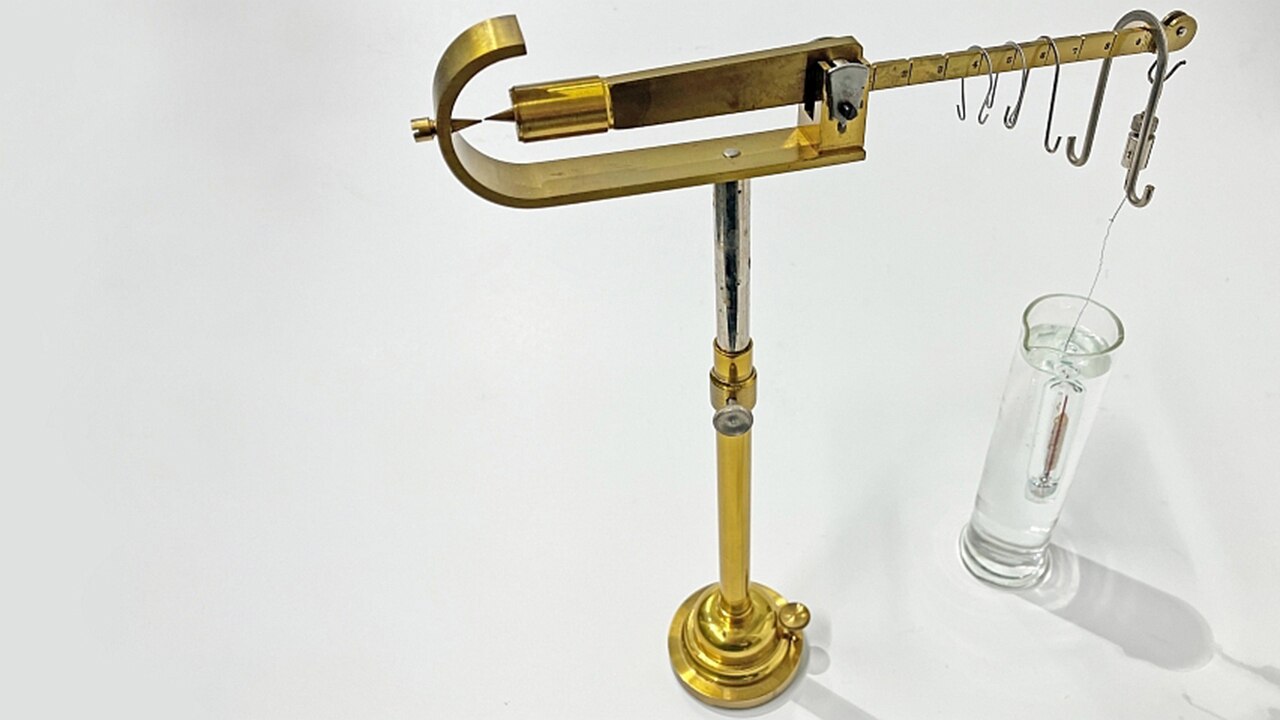
The “Mohr-Westphalian” or hydrostatic scales is an unequal-armed lever balance. It is used to determine the density of liquids by applying Archimedes' principle: The static buoyancy experienced by a body immersed in a liquid is proportional to the mass of the liquid displaced by the body - as formulated by the Greek mathematician and physicist, who lived in the 3rd century BC.

textblock default title
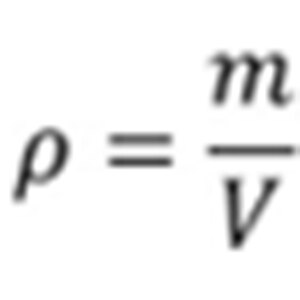
Thus, if the volume of the body is known, the density of the liquid can be deduced. The density of a sample is defined as its mass divided by its volume.
textblock default title
The invention and further development of the Mohr-Westphal scales are due to the pharmacist Karl Friedrich Mohr (1806-1879) and the precision mechanic Georg Westphal (1836-1902).
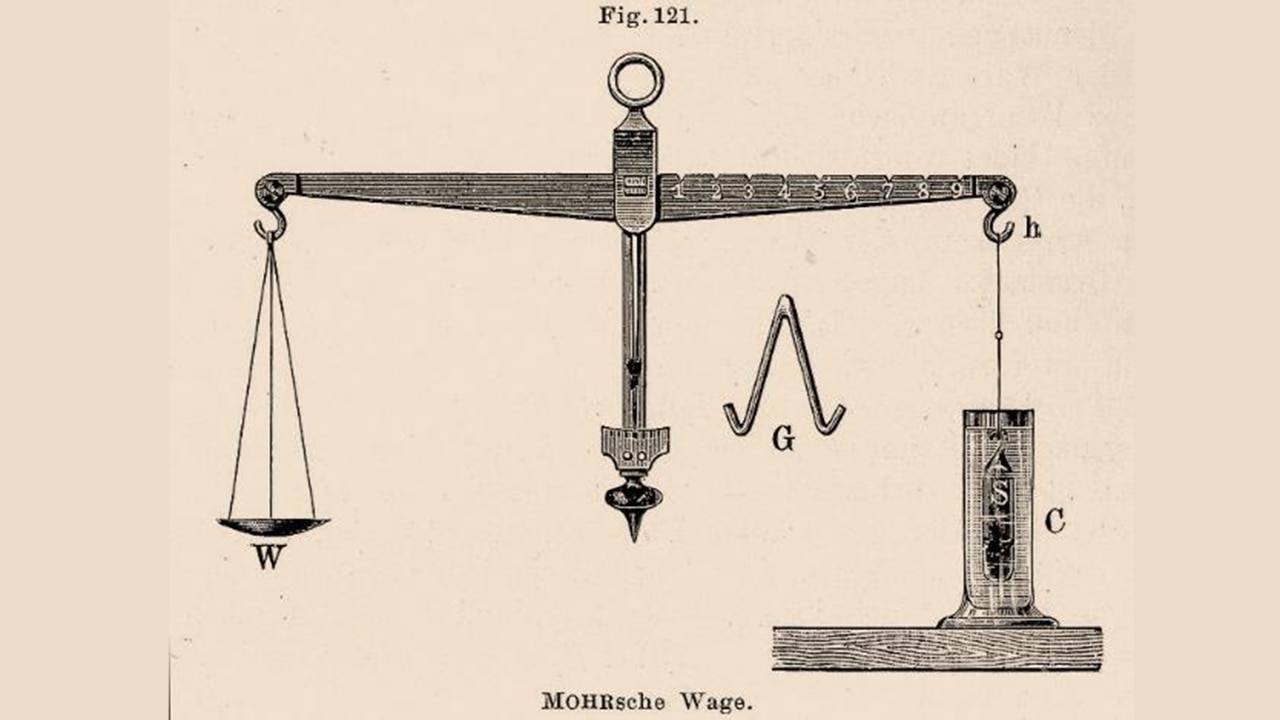
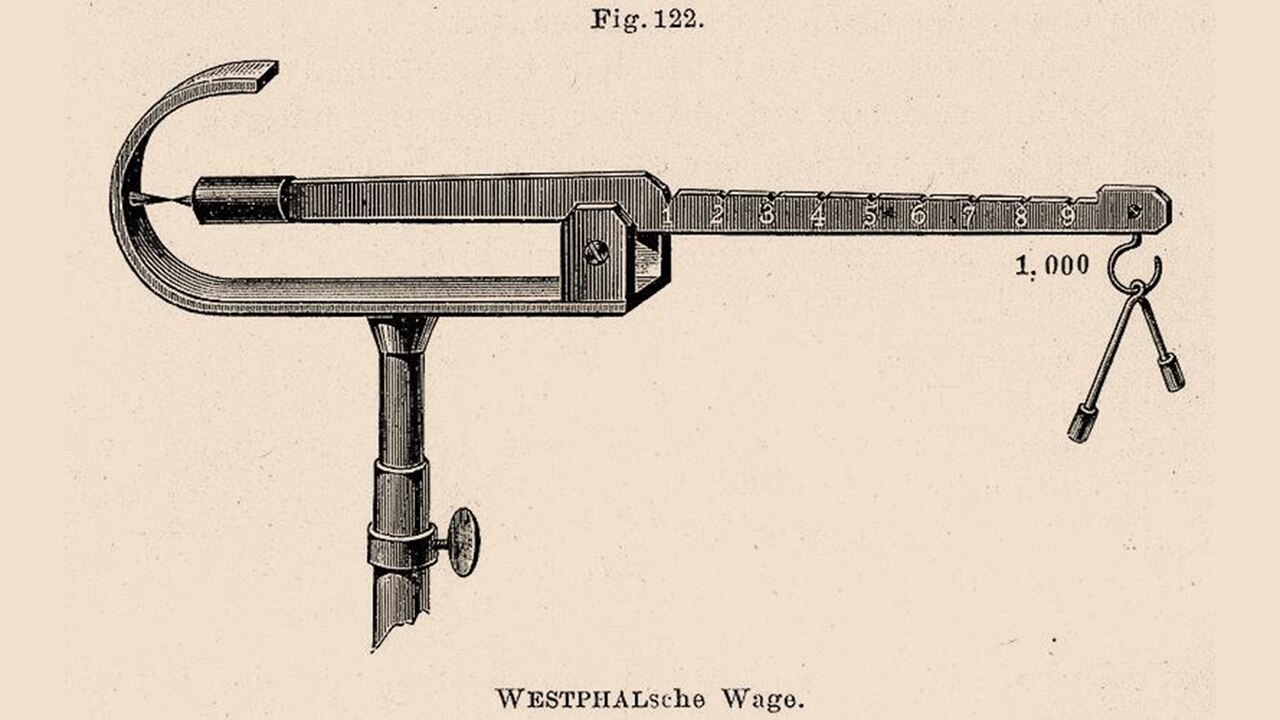
In 1848, Mohr gave his scales a vertical tongue - as was common with ordinary pharmacist's scales - which indicated the zero point on a scale. Westphal removed the pointer, shortened the left-hand balance beam and attached a counterweight with a tip to its end, which had to balance against a second tip when the apparatus was in equilibrium.
textblock default title
The scales combines two physical phenomena, the principle of buoyancy and the law of leverage. Using Archimedes' principle, the density value can be read directly to up to four decimal places after the balance has leveled out by placing pieces of the balance on it.
textblock default title
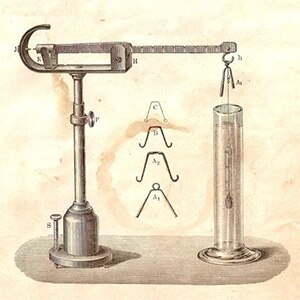
The scale can be calibrated using a screw on the base (S). A brass band is attached to the weighing column on a foot that is screwed to the column (P), which ends in a vertical bend on the left. The “center joint” of the balance beam is attached to the right end of the band.
A metal tip is attached in the middle of the bend and at the height of the middle of the balance beam (J). The end of the left part of the balance beam carries a counterweight with a spike (K). If the spike and the metal tip are at the same height, the scale is in balance; if necessary, it can be readjusted using the adjusting screw at the base of the scale.
The right-hand part of the balance beam is divided into tenths of its length by notches.
Instead of the 10th notch, a hook (h) is attached to a fine platinum wire which holds the plummet with thermometer. The sinker has a mass of 5 g and a volume of 5 cm3.
If the sinker is immersed in distilled water at a temperature of 4°C in the standing cylinder, the density of which should be 1 by definition, the buoyancy caused by the water is balanced by hanging the large rider (A1) on the hook of the right-hand balance beam. The balance is now in equilibrium again, as the weight of the large rider is equal to the weight of the amount of water displaced by the sinker.
If the vertical cylinder is filled with a liquid of greater density, the submersible body becomes buoyant because the amount of liquid displaced is heavier. The spike of the counterweight points downwards.
The first large rider (5 g A1) remains on the hook for the measurement. One large (5 g A2), one medium (0.5 g B) and one small (0.05 g C) tab are hooked into the following notches until the balance is in equilibrium. The density of the liquid can then be read off directly and is then 1.xxx. The second large tab gives the first decimal point of the density, the middle tab the second decimal point and the small tab the third decimal point.
If the density of the liquid is below 1, the first large tab is removed and the other tabs are hung in the notches 9 or 8 etc. until the tip of the balance beam is just below the tip of the stand. Then, with the help of the next smaller tab, the balance is established using the notches indicating the decimal places. The density is then 0.xxx.
textblock default title
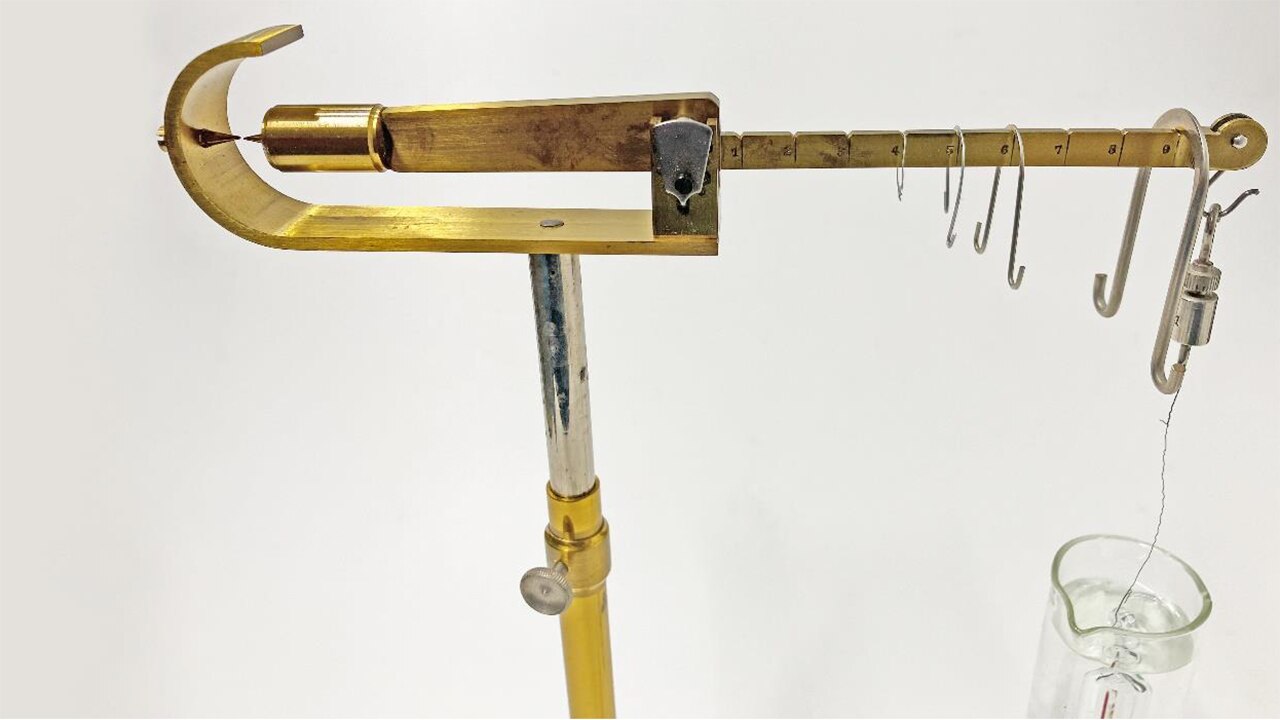
Example:
The sinker is in the liquid. When the balance is in equilibrium, the tabs are distributed as follows: 1 large tab (5g) in notch 9, 1 medium tab (0.5 g) in notch 6, 1 small tab (0.05 g) in notch 5, the smallest tab (0.005 g) in notch 4. The measured density value is therefore 0.9654 g/cm³.
These scales were mostly found in pharmacies. Patience, dexterity and a good eye were required. They were later replaced by electronic density meters, which were easier and quicker to use.